









Physics problems, solutions to email in these areas: measurement
and units; kinematics in one, two and three dimensions; vectors; force,
movement, dynamics, circular movement; gravitation; work, energy
and power; momentum, collisions, impulse; rotational movement;
static of a rigid body; fluids, density, pressure; oscillatory movement,
vibration; sound; temperature, kinetic theory; heat: first
thermodynamics law, second thermodynamics law; relativity;
electromagnetism: Coulomb's Law, electric field, electric potential,
Gauss' Law for the electric field, Ohm's law, Ampere Law,
Faraday's Law, Maxwell Equations, electromagnetic waves, photons;
optics: reflection, refraction, polarization, interference, diffraction.
Physics Homework: Problems - Solutions: for more details into
what type of problems we can attend, visit:
Physics Problems, Assignments Sent Via Email
PHYSICS PROBLEMS: Kinematics
As an illustration, here is a problem with its solution for you to see how it is sent
by email.
Some artillery men place an old cannon over the sea level at the top of a cliff.
The projectile is shooted horizontally with an initial velocity Vi. The cannon is
60 m above the sea level. The time taken since the instant the projectile is shot
until its impact is heard by the artillery men, is 4.0 s. Knowing that the sound
velocity in the air is 340 m/s, calculate the horizontal distance x from the impact
point on the sea to the base of the cliff and the initial velocity Vi of the projectile.
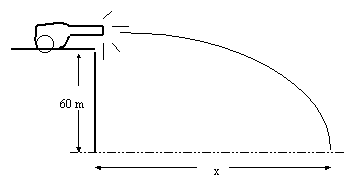 ANSWERS : x = 159 m; Vi = 45.4 m/s
Placing the origin of the coordinate system in the sea along with the cliff
and making x to show the horizontal distance and y for the altitude, we
have:
(A) x = Vi cos
ANSWERS : x = 159 m; Vi = 45.4 m/s
Placing the origin of the coordinate system in the sea along with the cliff
and making x to show the horizontal distance and y for the altitude, we
have:
(A) x = Vi cos t
(B) y = yi + Vi sen t - (1/2)gt2. yi is the initial vertical position.
In this case yi = 60 m, Vi is the magnitude of the initial velocity, is
the angle that the initial velocity vector makes with the x axis, in this
case = 0º because the shot is horizontal. So sen0º = 0 y cos0º = 1.
The time the projectile takes to reach the water is obtained doing y = 0.
y = 0 = 60m + Visen0º t - (1/2)gt2. Then,
(1/2)gt2 = 60m, from where t = 3,5 seconds.
Then, the time the sound takes to travel the distance between the impact
point and the cannon is 4s - 3,5s = 0,5s.
The distance between the impact point and the cannon is calculated using
the known relation: distance = velocity*time = 340 m/s*0.5 s = 170 m.
These 170 m form the hypotenuse of the rectangle triangle with 60 m and x
as the sides, then
x2 = (170m)2 - (60m)2.
Solving x in this triangle rectangle, x = 159 meters.
The initial velocity, when the shooting ocurred, can be calculated with the
equation (A)
x = Vi cos t
159m = Vi *1*3,5s
Then Vi = 45,4 m/s.
t
(B) y = yi + Vi sen t - (1/2)gt2. yi is the initial vertical position.
In this case yi = 60 m, Vi is the magnitude of the initial velocity, is
the angle that the initial velocity vector makes with the x axis, in this
case = 0º because the shot is horizontal. So sen0º = 0 y cos0º = 1.
The time the projectile takes to reach the water is obtained doing y = 0.
y = 0 = 60m + Visen0º t - (1/2)gt2. Then,
(1/2)gt2 = 60m, from where t = 3,5 seconds.
Then, the time the sound takes to travel the distance between the impact
point and the cannon is 4s - 3,5s = 0,5s.
The distance between the impact point and the cannon is calculated using
the known relation: distance = velocity*time = 340 m/s*0.5 s = 170 m.
These 170 m form the hypotenuse of the rectangle triangle with 60 m and x
as the sides, then
x2 = (170m)2 - (60m)2.
Solving x in this triangle rectangle, x = 159 meters.
The initial velocity, when the shooting ocurred, can be calculated with the
equation (A)
x = Vi cos t
159m = Vi *1*3,5s
Then Vi = 45,4 m/s.
Related Sites:
· Physics, Main Page
· Physics, Mathematics
· Physics, Detailed Homework Scope Help
· Energy, Work and Power: Concepts
· Kinetic Energy
· Potential Energy
· Power
· Physics Homework - Mechanical Energy Conservation Problems
· Physics Homework - Mechanical Power Problems
· Coulomb's Law
· Exercises Using Coulomb's Law
· Electric Field Charges
· Electric Field Exercises
· Electric Potential Energy
· Exercises, Electric Potential Energy
· Ohm's Law, Principle
· Ohm's Law Exercises
· Gauss' Law
· Gauss' Law Exercises
· Second Newton's Law
· Second Newton's Law Examples, Part One
· Second Newton's Law Examples, Part Two
· Sound Waves
· Sound Waves: Standing, Interference, Doppler Effect - Examples
· Sound Waves, Doppler Effect - Examples
· Vectors, Scalars
· Vectors, Scalars - Analytic Method
· Addition Vector Tools, Problems
· Free Fall Theory
· Free Fall Exercises, Part One
· Free Fall Exercises, Part Two
· Free Fall Exercises, Part Three

